Queer Places:
Dromoland Castle (now Dromoland Castle Hotel), Dromoland, Newmarket on Fergus, Co. Clare, V95 ATD3, Ireland
Harrow School, 5 High St, Harrow HA1 3HP, United Kingdom
University of Cambridge, 4 Mill Ln, Cambridge CB2 1RZ
Smith O'Brien's Cottage, Port Arthur TAS 7182, Australia
Rathronan Cemetery, Glenville, Ardagh, Co. Limerick, V42 YY65 Ireland
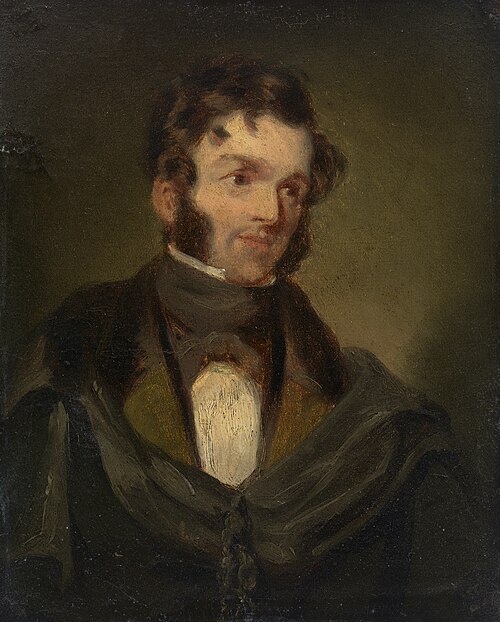 William Smith O'Brien (October 17, 1803 – June 16, 1864) was an Irish nationalist leader, Member of Parliament, and central figure in the Young Ireland movement who
transitioned from a loyal unionist to a convicted revolutionary during the Great Famine.
William Smith O'Brien (October 17, 1803 – June 16, 1864) was an Irish nationalist leader, Member of Parliament, and central figure in the Young Ireland movement who
transitioned from a loyal unionist to a convicted revolutionary during the Great Famine.
Born on October 17, 1803, at Dromoland Castle in County Clare, William Smith O'Brien was the second son of Sir Edward O'Brien, the 4th Baronet, and Charlotte Smith.
Through the Dromoland line, he was a direct descendant of the eleventh-century High King of Ireland, Brian Boru. His mother was the daughter of William Smith of Cahirmoyle,
County Limerick, a property William later inherited, adding Smith to his surname.
He received an elite English education at Harrow School before entering Trinity College, Cambridge, in 1821, graduating with a Bachelor of Arts in 1826. During his time
at Cambridge, he joined the Cambridge Apostles—a prestigious, highly selective intellectual secret society—and served as
President of the Cambridge Union Society in 1831. Following university, he studied law at Lincoln's Inn in London and King's Inns in Dublin, though he never actively
practiced law.
O'Brien entered public office as a traditional Tory, representing his father's pocket borough of Ennis from 1828 to 1831. Although a Protestant landowner, he notably
broke with his family's traditional stance by supporting Catholic Emancipation in 1828 and 1829. After a brief period out of parliament, he successfully contested County
Limerick as an independent Whig/Liberal, holding the seat from 1835 until his exclusion in 1849.
During his early parliamentary tenure, O'Brien established a reputation as a diligent reformer focused on Irish economic and social welfare. He was a constant advocate
for improved public education, infrastructure development, and systematic poor relief, publishing works such as Plan for the relief of the poor in Ireland (1831). He also
maintained strong imperial interests, associating with Edward Gibbon Wakefield's colonization theories and serving as a founding member of the National Colonisation
Society.
Initially an ardent supporter of the legislative union between Great Britain and Ireland, O'Brien's political outlook shifted dramatically during the early 1840s. In
protest against the British government's dismissal of magistrates who attended Daniel O'Connell's peaceful "monster meetings," O'Brien resigned his position as a Justice of
the Peace. In October 1843, he officially joined O'Connell's Repeal Association, rapidly rising to a position of leadership second only to O'Connell himself.
Within the association, O'Brien aligned closely with the younger, more radical intellectuals centered around Charles Gavan Duffy and the nationalist newspaper The Nation,
who were dubbed "Young Ireland" by a disapproving O'Connell. The ideological rift widened over the role of physical force and non-sectarian education. In July 1846, when
O'Connell demanded that all members sign a pledge utterly renouncing the use of revolutionary force under any circumstances, O'Brien led the Young Ireland faction in a
dramatic secession from the Repeal Association, subsequently helping to establish the Irish Confederation.
The onset of the Great Famine radicalized O'Brien, who grew increasingly despairing of achieving justice or adequate famine relief for Ireland through constitutional
means. Following the February 1848 revolution in the Second French Republic, O'Brien and Thomas Francis Meagher traveled to Paris to seek moral support from the new French
revolutionary government, returning to Ireland with the first Irish tricolour flag—designed to symbolize the union of Catholics (green) and Protestants (orange).
After the British government suspended habeas corpus and arrested fellow leaders like John Mitchel and Charles Gavan Duffy, O'Brien reluctantly took command of the
disorganized physical-force movement. On July 23, 1848, he raised the standard of revolt in County Tipperary. However, the anticipated mass rising failed to materialize.
Hampered by the opposition of the Catholic clergy, widespread starvation among the peasantry, and a lack of military preparation, O'Brien's forces engaged in only a brief
skirmish with the constabulary on July 29 at Widow McCormack's house in Ballingarry, derisively dubbed the "Battle of Widow McCormack's Cabbage Patch."
Following the collapse of the insurrection, O'Brien was arrested at the Thurles railway station on August 7, 1848. Tried for high treason at a special commission in
Clonmel, he and three co-defendants—Thomas Francis Meagher, Terence MacManus, and Patrick O'Donoghue—were sentenced to be hanged, drawn, and quartered. Following an
international public outcry and petitions bearing tens of thousands of signatures from Ireland and England, the British government commuted the sentence to transportation
for life.
In late 1849, O'Brien was transported to Van Diemen's Land (modern-day Tasmania, Australia). Initially refusing to give his parole, he was held in strict isolation at the
penal stations of Maria Island and Port Arthur, where he made an unsuccessful escape attempt. By late 1850, he accepted a ticket-of-leave, settling first as a tutor in Avoca
and later living comfortably in New Norfolk, where he maintained cordial relations with fellow political exiles and local settlers.
Due to intense lobbying by British parliamentarians and his family, O'Brien received a conditional pardon in 1854, allowing him to leave Tasmania. He settled temporarily
in Brussels, Belgium, where he published his two-volume political treatise, Principles of Government, or Meditations in Exile (1856), and became a founding member of the
Ossianic Society, dedicating himself to the study and revival of the Irish language.
In May 1856, he was granted an unconditional free pardon by Lord Palmerston's government and returned to July to Ireland amid public celebrations. Although hailed as an
elder statesman of Irish nationalism, he refused to return to active parliamentary politics or endorse the secret, revolutionary methods of the later Fenian movement.
Instead, he focused on estate management, local poor law administration, cultural pursuits, and extensive foreign travel, including visits to Canada, the United States,
Hungary, and Poland.
O'Brien passed away at Bangor in North Wales on June 16, 1864, after suffering a heart attack aggravated by chronic liver illness. His remains were returned to Ireland
and interred in the family mausoleum at Rathronan churchyard in County Limerick. In 1870, a prominent limestone statue sculpted by Thomas Farrell was erected in his honor,
which now stands on O'Connell Street in Dublin.
References:
Other references:
- National Library of Ireland (NLI): Holds the principal collection of William Smith O'Brien papers (MSS 46,818–46,830 and various other accessions). The collection includes his original Tasmanian and European travel journals, legal defense drafts for his 1848 trial, an autobiographical memoir, and extensive political and literary correspondence with contemporaries like Thomas Davis, Charles Gavan Duffy, and John Mitchel.
- Royal Irish Academy (RIA): Custodian of the collection of 43 Irish-language manuscripts bequeathed by Smith O'Brien in 1865. These reflect his active engagement with the Ossianic Society and Gaelic literature, featuring texts collected or copied in his own hand alongside nineteenth-century Clare scribal works.
- National Archives of Australia / Australian Joint Copying Project (AJCP): Microfilmed records (M1980–M2003) capturing his penal administration files, correspondence from Van Diemen's Land, and interactions with fellow political exiles.
- Archives Office of Tasmania: Official colonial records detailing his assignment to Maria Island and Port Arthur (including files Ac. nos. 2/306, 2/315, and 2/363).
- Plan for the relief of the poor in Ireland (Dublin, 1831).
- Considerations relative to the renewal of the East-India Company's charter (London, 1830).
- Principles of Government, or Meditations in Exile (2 vols., Dublin, 1856).
- Reproductive Employment; A Series of Letters To The Landed Proprietors of Ireland.
- Report of the trial of William Smith O'Brien, for high treason, at the Special commission for the co. Tipperary, held at Clonmel, September and October, 1848 (Dublin, 1848).
- Contributions of political and patriotic verse to The Nation and The Sydney Freeman's Journal.
- Davis, Richard (ed.). 'To solitude consigned': The Tasmanian journal of William Smith O'Brien. Sydney: Crossing Press, 1995.
- Davis, Richard. The Rebel in His Family: Selected Papers of William Smith O'Brien. Cork: Cork University Press, 1998.
- Gwynn, Denis R. Young Ireland and 1848. Cork: Cork University Press, 1949.
- Kiernan, T. J. The Irish Exiles in Australia. Melbourne: Melbourne University Press, 1954.
- Touhill, Blanche M. William Smith O'Brien and His Revolutionary Companions in Penal Exile. Columbia: University of Missouri Press, 1981.
- Cullen, J. H. Young Ireland in Exile. Dublin: Talbot Press, 1928.
Support this project
This website is a passion project researched, developed, and funded entirely by me. If you find the content valuable and would like to help support the ongoing research and hosting costs, any contribution is deeply appreciated.
Thank you for keeping this independent resource alive!
My books on Amazon: Elisa Rolle's books
BACK TO HOME PAGE
